


Africa is making a hard pivot on artificial intelligence: not as a buzzword, but as a power play.
At a major regional gathering in Conakry, Guinea, the pan-African initiative Smart Africa announced the creation of the continent’s first African AI Council, an effort leaders are framing as essential to sovereignty, economic leverage, and national security. The message is blunt: AI governance is moving into the same category as energy grids, highways, and defense.
The push comes as the global AI race is dominated by U.S. and Chinese giants, with new generative AI products also pouring in from Asia. African governments are trying to avoid a familiar trap, becoming a captive market that supplies raw data to foreign platforms while importing the models, the computing muscle, and the rules.
Smart Africa bets on a high-profile African AI Council
Smart Africa says the new African AI Council will serve as a continent-wide hub for governance, innovation, and what officials call “digital sovereignty.” The initiative is backed by 42 heads of state involved in Smart Africa, along with the African Union Commission (the AU’s executive arm, roughly comparable to a regional federal bureaucracy) and the International Telecommunication Union, a U.N. agency that sets global telecom standards.
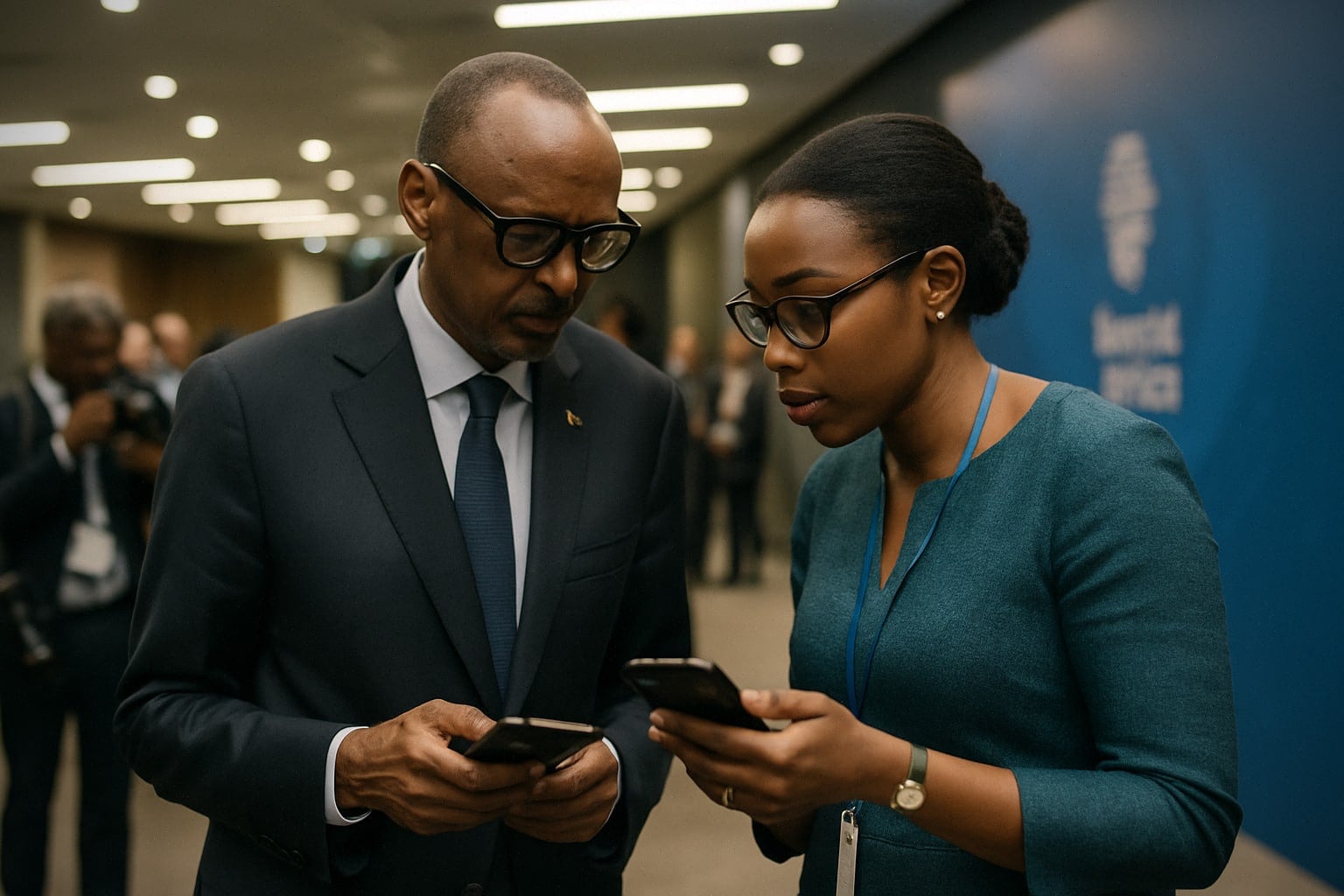
Rwanda’s President Paul Kagame, one of Africa’s most influential tech-forward leaders, will chair the council, a choice designed to keep AI on presidents’ desks rather than buried in ministries. Smart Africa CEO Lacina Koné summed up the ambition in a line: Africa should be a creator of AI, not just a consumer of it.
Organizers say the council drew more than 400 applications from 57 nationalities, with selections made alongside the African Union and the ITU. That number signals a deep bench of talent, spread across government, academia, private industry, and the diaspora, but the real test will be turning expertise into budgets, enforceable policy, and measurable outcomes.
The council is also launching into a messy global landscape. There’s no single worldwide AI rulebook, and proposals for an “IAEA-style” international body for AI, akin to the nuclear watchdog, remain more theory than reality. For many African governments, the practical path may be regional standards that can plug into major global regimes while preserving local control over sensitive areas like digital ID systems, public services, health care, and security.
Data is the new leverage, and the new vulnerability
At the center of the sovereignty debate is data: who collects it, where it’s stored, how it moves, and who profits from it. Controlling data flows doesn’t necessarily mean walling off the internet. It means having enforceable laws, credible regulators, and the technical ability to audit what’s happening inside networks and platforms.
Generative AI raises the stakes because models need massive volumes of data, and not just any data. They need high-quality, locally relevant information that reflects African languages, legal systems, and day-to-day realities. Without a strategy, governments risk watching local data fuel foreign models while becoming dependent on outside tools for critical services such as translation, digital education, precision agriculture, and AI-assisted medical diagnostics.
Several governments are already trying to pull key administrative databases back under tighter national control, systems often described as the “brain” of the state. That shift forces practical questions that quickly become political: Where do the servers sit? Who can access them? Which country’s laws apply when something goes wrong?
Public trust is another pressure point. As biometric ID programs and other sensitive digital services expand, citizens’ willingness to adopt them can collapse if privacy protections look weak or opaque. Where data protection authorities exist, and have real resources, they’re increasingly central to whether digital government projects succeed.
And the goal isn’t only defense. Countries also want to create local economic value, jobs, services, and homegrown companies, rather than exporting data as a raw commodity and buying back finished products.
Cloud, cables, and computing power are now strategic infrastructure
AI sovereignty doesn’t happen without infrastructure: cloud services, data centers, undersea cables, internet exchange points, and, most importantly for modern AI, serious computing capacity. In today’s tech rivalry, the countries that control these building blocks set standards, capture profits, and shape everyone else’s dependencies.
For African governments, the question isn’t just whether to build data centers, but under what terms: ownership, governance, energy supply, redundancy, backup locations, and legal compliance. When public services migrate to external platforms, officials worry about continuity of operations, confidentiality, and whether local law can actually be enforced.
AI makes the compute problem even sharper. Training or even adapting advanced models can be extremely expensive, and the world’s biggest compute clusters are concentrated in a handful of regions. That leaves many African institutions facing a tradeoff: rent capacity abroad to move fast, or invest in local infrastructure that’s slower to pay off but strategically vital, especially for sectors like health, taxation, digital identity, and defense.
Even with local servers, dependence can hide in software layers: managed services, proprietary model libraries, licensing, and AI marketplaces. International partnerships will still matter, particularly for training and access to research, but governments increasingly want deals that include skills transfer and transparency requirements.
With budgets tight, the article’s core argument is that countries may need to prioritize projects with regional spillover, interconnected “sovereign cloud” networks or shared compute platforms that can support universities and startups across borders.
Cybersecurity is escalating, and AI cuts both ways
Digital sovereignty collapses fast if systems can’t withstand attacks. Across the continent, threats are intensifying: ransomware, phishing, espionage, and sabotage. Warnings about rising cyber threats in Nigeria in 2026 are cited as one example of a broader trend as banks, hospitals, telecoms, and government agencies digitize at speed.
AI accelerates both offense and defense. Attackers can automate phishing and craft more convincing scams; defenders can use AI to spot anomalies, triage alerts, and speed incident response. But those tools only work well when organizations have strong data logs and trained teams, without skilled analysts, AI security platforms can become expensive dashboards that no one fully uses.
Some governments are also deploying AI for surveillance, facial recognition, border monitoring, and large-scale pattern analysis. The article points to Morocco as an example discussed in regional analysis, underscoring the democratic governance challenge: powerful tools can slide into intrusive practices when legal guardrails are weak.
Supply-chain risk is another weak link, hardware, software, contractors, and maintenance. A sovereignty strategy, the article argues, doesn’t require cutting off global technology. It requires knowing where the risks are, auditing vendors, setting certification requirements, and building resilience through offline backups, continuity plans, and regular drills.
Finally, scale matters. A single country can’t easily fight transnational cybercriminal networks alone. Regional cooperation, shared alerts, stronger incident response teams (CERTs), and common procedures, may determine who can absorb the next wave of attacks. AI won’t be a magic shield; it will amplify the power of whoever already has the infrastructure and talent.

Key Takeaways
- Smart Africa launches the first African AI Council, backed by 42 countries.
- Digital sovereignty depends on controlling data—its collection, storage, and use.
- Cloud infrastructure, data centers, and compute capacity determine AI autonomy.
- Cybersecurity tightens in 2026; AI accelerates both attacks and defenses.
Sources
- Révolution numérique | Intelligence artificielle : l’Afrique se dote de son premier conseil
- Souveraineté numérique : quels enjeux pour l’Afrique ? | Cairn.info
- Le Maroc et la géopolitique de l’IA | le360.ma
- Géopolitique du numérique : quels rapports de force et enjeux de gouvernance ? – IRIS
- L'Économie et la Géopolitique de l'Intelligence Artificielle | ITCurated

- Comment préparer la mise en place d’un ERP sans perturber son activité ? - 5 octobre 2026
- Protection sociale des professions libérales médicales : le guide complet pour bien s’assurer - 23 septembre 2026
- Abonnement IPTV : le bon plan pour votre facture télé - 23 septembre 2026